Francisco Montegrifo
La piel del tamborFrancisco Montegrifo is a Madrid art dealer whose suspected role in two irregular art-and-antiquities transactions links an earlier church-art scandal to the investigation of the substituted pearls at Nuestra Señora de las Lágrimas. He remains a figure reconstructed through contacts and circumstantial evidence: police identify a plausible route for the pearls and a possible financial motive, but do not establish his guilt.
Identity and Earlier Connection
Montegrifo is identified as a Madrid-based dealer and as a contact of Príamo Ferro in the irregular sale of an altarpiece from Cillas de Ansó. That transaction had taken place ten years before the investigation of the church’s pearls. The earlier connection makes Montegrifo relevant when investigators try to trace the provenance of objects associated with Ferro, but it does not by itself prove that he participated in the later substitution.
The Pearl Investigation
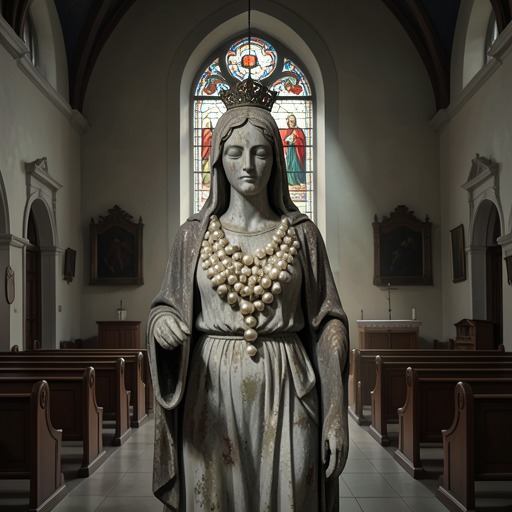
The police inquiry establishes that the pearls on the Virgin’s image had been replaced months earlier by twenty identical imitations. Subcommissioner Simeón Navajo tells Lorenzo Quart that the indications once again point to Montegrifo, who had allegedly put Captain Xaloc’s pearls into circulation. A batch found with a Catalan jeweler and police informant, an expert in laundering illegally acquired goods, matched the description. Investigators had not determined the trail exactly, and the match supported suspicion rather than certainty.
Possible Motive and Limits of the Case
The informant’s dating of the pearls’ circulation coincided with the resumption of work at Nuestra Señora de las Lágrimas. During that period, building materials were purchased and machinery was hired; suppliers contacted by Navajo’s men said the costs exceeded what the parish priest’s salary and the church collection could cover. This financial discrepancy gives the investigators a possible link between the pearls and the restoration work, while leaving unresolved who arranged the sale and where the money went.
Navajo’s reconstruction is that Honorato Bonafé discovered the imitations at the church and was killed after confronting Ferro—perhaps in an attempted blackmail, perhaps before he could make one. Montegrifo’s suspected role belongs to the separate chain tracing the pearls and their possible proceeds; the available evidence does not establish that he killed Bonafé or even prove that he personally mediated the transaction. His narrative function is therefore investigative rather than testimonial: the earlier Ferro connection and the uncertain trail through the art market offer a credible lead, but not a conclusive solution.